The Quiet Journey of the Pickle Jar
The pickle jar’s history explains how brining helped households keep vegetables and how pickles became a distinctive, flavourful part of the meal.
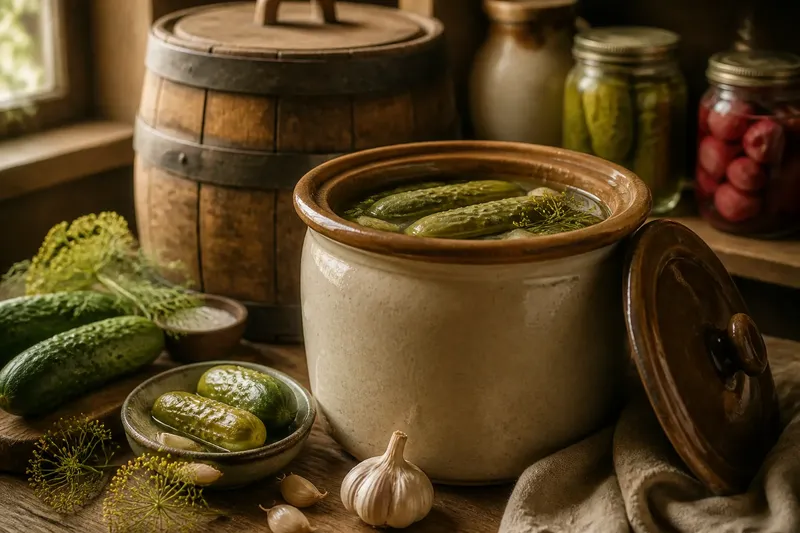
A crock of brined cucumbers could sit in a household store while fresh vegetables were out of season. The pickle jar’s history begins with that practical aim: preserving a crop for later, long before the glass jar became the familiar container on a pantry shelf.
Brining was not one fixed recipe or a single invention. People used local crops, available vessels and inherited methods, producing foods that could serve as provisions, meal accompaniments or both.
Why did people brine vegetables?
A harvest might yield more vegetables than a household could eat while they were fresh. Keeping some in a salty liquid offered a way to use that surplus later, rather than relying on fresh produce alone.
In fermented brines, naturally occurring microbes convert some vegetable sugars into acids. That process gives the vegetables a tang, but the precise flavour and texture depend on the ingredients and conditions. Other pickled vegetables are preserved by different methods, so sourness alone does not tell you how a pickle was made.
Cucumbers, cabbage, radishes and turnips all suited preservation in different ways. Local growing conditions and food customs shaped which vegetables people chose and how they prepared them.
How did crock, barrel and jar serve different needs?
Before glass jars became a common household option, people used vessels available in their communities, including earthenware crocks and wooden barrels. A larger vessel suited a substantial store of vegetables; a smaller one was easier to keep for ordinary meals. The material and shape affected the work of packing, covering and storing the food.
Keeping vegetables beneath the brine was important in many traditions. Weights, covers or lids could help keep the contents submerged and protected from dirt and pests. These details varied by vessel and practice; historical methods should not be treated as interchangeable instructions for safe preservation today.
Say a household has more cucumbers than it can eat fresh. In this invented situation, its members choose a food-safe crock, pack the cucumbers beneath brine and cover the vessel; the expected result is a stored batch they can draw on later, rather than cucumbers left to soften. The example illustrates the purpose of the vessel, not a claim that any particular historical method was safe or successful.
How did preserved vegetables find a place at the table?
As well as helping store a harvest, pickles added a sharp, salty taste and a crisp or yielding texture to meals. A small serving could accompany bread, grains, beans or meat, giving the plate a contrast that fresh vegetables did not always provide.
That role varied with local foodways. A household might favour cabbage while another preferred cucumbers or roots; tastes for mild or pronounced sourness differed too. The broad practice of preserving vegetables travelled across communities, while ingredients and preferred flavours remained rooted in place.
Pickles could therefore outlast the circumstances that first made preservation useful. Even when a household had fresh food, a preserved vegetable might still earn its place for its flavour and texture.
What changed as glass jars and trade expanded?
Glass containers eventually gave households and sellers a way to see the contents, and could be closed for storage. The timing and extent of their adoption differed by place, so it is better to think of the jar as one development in a long history of food containers, rather than as a sudden replacement for crocks and barrels.
As trade and transport changed, preserved foods could reach customers farther from the places where vegetables were grown. In some settings, this helped pickles move from household stores into commercial sale. The shift was gradual and uneven, shaped by local access to containers, markets and transport; it did not end home preservation.
Commercial products also make clear that “pickle” covers different preparations. A fermented pickle is not necessarily made in the same way as one preserved by another process. For present-day storage and food-safety decisions, follow the product label and manufacturer’s directions.
What questions help make sense of pickle history?
Why did brine help preserve vegetables?
Salt changed the conditions around the vegetables, while fermentation could produce acids that contributed to their tang. Results depended on the ingredients and handling, so brining did not produce one uniform kind of pickle.
Were pickles always stored in glass jars?
No. Earthenware crocks and wooden barrels, among other locally available vessels, served different storage and transport needs. Glass jars became familiar over time, with adoption varying across places.
Was every pickle fermented?
No. The word “pickle” describes vegetables preserved by different methods, and a sour flavour does not identify which method was used. For a commercial product, the label can clarify how it was prepared.
Why eat pickles when fresh vegetables are available?
Pickles bring a concentrated taste and a distinct texture to a meal. Their role can be about flavour and contrast, not only about keeping food for a time when fresh vegetables are scarce.
What can the pickle jar tell us about food history?
The pickle jar points to several connected choices: what a community grew, how it stored a surplus, which vessels it could use and what flavours people wanted at the table. Keeping those questions distinct makes the history clearer than treating every pickle as a response to scarcity alone.
When you next see a jar of pickles, consider both its method and its role: a fermented food, a preserved ingredient, a commercial product or a sharp accompaniment. That small distinction links the pickle jar’s history to the everyday choices that still shape a meal.