The Recipe Must Be Authentic Myth
The recipe must be authentic myth overlooks how families, regions and circumstances shape a dish. Learn to read recipes as living records, not fixed laws.
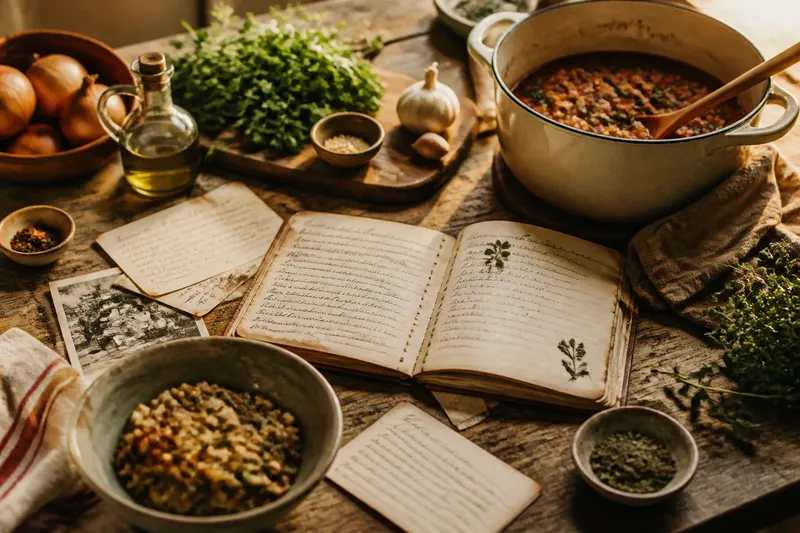
Ask whether a dish has one authentic recipe, and someone may point to a handwritten card, a regional version or a family rule. The recipe must be authentic myth treats those answers as competitors, when each may tell a different story about who cooks the dish and why. Recipes are better read as records of choices than as laws with a single authorised wording.
1. Who taught the cook?
A recipe often travels through people before it reaches a page. A parent may teach a child by describing the smell of onions when they are ready, while a neighbour adds a pinch of something without naming it. Later, the cook writes down only the parts that seem easy to forget.
That leaves gaps, but not necessarily mistakes. “Cook until soft” can carry the memory of a particular pan, flame and household rhythm. Someone learning from another cook may need to ask what “soft” looks and feels like, rather than assume the instruction is incomplete.
When you inherit a recipe, ask which details were taught by demonstration and which were written down.
2. Which region is the recipe speaking for?
Regional cooking is not a neat set of boundaries. Neighbouring towns may use different names for a similar dish, or disagree over which herb belongs in it. A recipe associated with one place might also reflect migration, trade, religious practice or the ingredients available to a particular household.
That is why a claim such as “the real version always uses this” deserves a follow-up: real to whom, and in which kitchen? A regional recipe can be meaningful without representing every cook from that region. It may be one strong local tradition among several.
Say you find two versions of a lentil dish, one flavoured with cumin and another with mint. If each comes from a different family in the same broad area, the useful observation is not that one has failed. It is that taste, local custom and household inheritance can create neighbouring traditions.
3. What was available when the dish was made?
Recipes respond to circumstance. A cook might use dried beans when fresh ones are out of season, stretch a stew with bread, or substitute a locally grown leaf for one that is hard to obtain. Such choices can become familiar enough to pass from necessity into preference.
Substitution does not make every version interchangeable. Ingredients bring their own texture and flavour, and some changes shift the character of a dish more than others. But the question “What did the cook have?” can explain a version more clearly than a search for a supposedly pure original.
Look for the practical pressures behind a recipe: season, cost, storage, available fuel, dietary custom and the size of the household.
4. What can a written recipe leave out?
A printed recipe has to make tacit knowledge visible, and it cannot always do so. It may specify an ingredient but not the cut, describe a sauce as thick without saying how it should coat a spoon, or assume that the reader recognises when dough is ready. Experienced cooks often adjust by sight, sound and touch.
Those sensory cues are not a licence to ignore the recipe. They are a reminder that instructions meet different equipment and ingredients in different kitchens. A heavy pot may hold heat differently from a thin saucepan; a coarse grind may absorb liquid differently from a fine one.
Read the method as a conversation with the food, not merely a set of words to obey.
5. How can you compare versions without choosing a winner?
Compare recipes by asking what each one makes possible. Note the shared structure, then notice the differences in seasoning, technique, texture and occasion. One version may be designed for a celebration; another may be the quick supper people make without consulting a page.
Imagine a cook comparing two family recipes for stuffed vegetables. One uses rice and herbs, while the other includes leftover bread and a sharper sauce. The cook could prepare each as written, then describe the distinct texture and flavour, rather than declaring one the authentic version. That comparison gives the family more to discuss and preserves the reason each recipe matters.
If you adapt a recipe, make a small note of what you changed and what the dish became. That creates a useful trail for the next cook.
6. What should you ask about a recipe?
Does “traditional” mean old or simply familiar?
It can mean either, or both. Ask who uses the word and what practice they are describing; a dish can be traditional within a family even if it is not shared across a whole region.
Can a recipe change and still belong to the dish?
Often, yes: cooks may alter ingredients or technique while retaining a recognisable structure, name or place at the table. Which features matter most is a question for the people who make and eat it.
Should I follow a family recipe exactly?
Follow it closely if your aim is to reproduce a remembered version, but treat unclear quantities as prompts to ask the cook or observe the method. If you are adapting it, keep a note so the distinction between inherited detail and your own choice stays clear.
How do I describe a recipe without calling it the only authentic one?
Name its source as specifically as you can: a family, locality, community or occasion, when that information is known. If it is your own adaptation, say so plainly and describe what you changed.
7. What does authenticity mean at your table?
Authenticity need not be a certificate awarded to one version. It can mean being honest about where a recipe came from, how it changed and whose knowledge it carries. A cook can honour a family method while recognising that relatives may remember it differently.
That distinction matters when recipes are shared beyond the household. Naming a dish’s connection to a particular community is more informative than presenting one convenient version as universal. It also leaves room for cooks from that community to disagree, adapt and explain their own practice.
The recipe must be authentic myth becomes easier to question once you ask whose version is being preserved. Keep the source with the instructions, and leave space for the next cook to add their own note: a memory, a seasonal swap or the cue that tells them the dish is ready.